|
1
|
|
|
2
|
- What do we know?
- Statistical Verdict Studies
- Surveys
- Mock Jury Experiments
- What can we extrapolate from what we know?
- Related Studies
- Experience with Similar Cases
- What do we need to study?
- Run our own survey, focus group or mock trial
|
|
3
|
- Meter Readers (Lopes, 1986, Hogarth and Einhorn, 1992)
- Algebraic
- Balancing
- Anchoring and Adjustment
- Story Tellers (Pennington and Hastie, 1991)
- Narrative Construction
- Seek Coherence
- More prevalent
|
|
4
|
- It is important (but hard) to get a jury to identify with your client.
- Let the client tell a personal story
- Make the case about a person, not a company
- Medical personnel make good defendants
- A witness who teaches the jury something useful gains credibility
- Keep the client on a positive message
|
|
5
|
- Jurors tend to treat low a probability event that actually occurs as
much more likely than it is.
- Jurors will believe it to have been more easily anticipated and will
assign greater urgency to guarding against it.
- Jurors often conclude that manufacturers, utilities and doctors should
have anticipated every contingency.
- Jurors can be quick to blame victims who engage in intrinsically risky
behavior, regardless of who might have been negligent
- A second order effect is that the more bizarre the circumstances, the
more jurors tend to believe that it must have been “somebody’s fault.”
- One strategy for overcoming hindsight bias is to argue by analogy to
something familiar to jurors.
|
|
6
|
- Jurors HATE cost-benefit analysis!!!
|
|
7
|
- Give Instructions First.
- Improves Jury Recollection of Relevant Information (Elwork, Sales, and
Alfini, 1977)
- Defanging
- Offering bad news yourself allows jurors to provide counter-arguments.
- Example: The “Hired Gun” effect.
|
|
8
|
- Defense Bias (Good!)
- Pro-defense jurors tend to stick to their guns more than pro-plaintiff
ones.
- An initially split jury rarely goes for the plaintiff.
- Try to get pro-defense jurors to commit early
- Aggregation Bias (Bad!)
- Damage awards almost always exceed the mean of individual juror
evaluations.
- Awards often exceed the amount initially proposed by any juror.
|
|
9
|
- A variety of strategies are employed (Goodman, Greene, and Loftus, 1989)
- “Ad damnum” is often used as anchor for award. (Zuehl, 1982). Also,
expert’s testimony.
- A “counter-anchor” can affect the jury’s calculations. (Raitz, et al.,
1990)
- Itemized verdict forms can reduce excessive damage awards. (Zuehl, 1982)
- Damage caps can increase average awards by providing the jury with a
high anchor
|
|
10
|
|
|
11
|
- Punitive Damages are most common in business cases (contract, fraud,
employment) according to Eisenberg, et al., not torts cases.
- The request for punitive damages tends to increase the size of the
compensatory award, even if no punitive damages are awarded.
- When conduct is egregious and punitive damages are capped or
unavailable, juries react by increasing compensatory awards
|
|
12
|
|
|
13
|
|
|
14
|
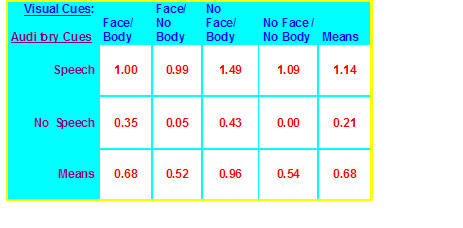
- Do jurors infer truthfulness of testimony from verbal and visual cues?
- Subjects saw/heard taped testimony which varied along three dimensions:
- Audible Speech.
- Visible Body.
- Visible Face.
- Some subjects only read a transcript of testimony.
|
|
15
|
|

 Notes
Notes